Mormon frequently wrote, “and thus we see,” to highlight some moral that he wanted his readers to see in his writings. Now it’s your turn. For each listed passage, indicate in your own words the principle or moral that you believe Moroni wanted us to learn from reading Ether, and give a modern application of that principle.
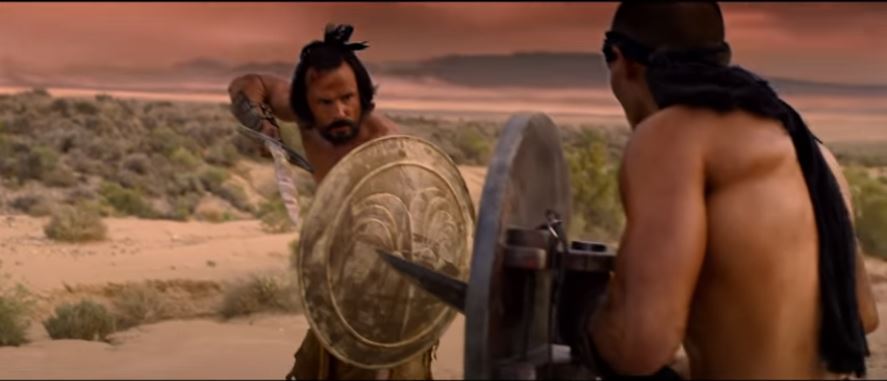
Coriantumr and Shiz
1. 12:2-3
2. 12:4
3. 12:6, 12
4. 12:24
5. 12:26-27
6. 12:30
7. 12:36-37
8. 12:38-41
9. 13:2-10
10. 13:13
11. 13:20
12. 15:17-19
13. 15:33
14. 15:34
Possible Answers to Points to Ponder in Ether 12-15
Mormon frequently wrote, “and thus we see,” to highlight some moral that he wanted his readers to see in his writings. Now it’s your turn. For each listed passage, indicate in your own words the principle or moral that you believe Moroni wanted us to learn from reading Ether, and give a modern application of that principle.
1. 12:2-3
When we are full of the Spirit of the Lord, we feel like working hard all day long in the Lord’s work.
2. 12:4
Faith leads to hope and an assurance of a better life hereafter, which can make us sure and steadfast, always abounding in good works.
3. 12:6, 12
We receive no witness until after the trial of our faith. For example, there will never seem to be enough money for tithing until after we pay it, and we’ll never think we can succeed at a new calling in the Church until we accept it and give it a try. For further commentary on this principle, see my post at https://latterdaysaintandhappy.com/god-says-after-you-first-shall-be-first/
4. 12:24
It’s not enough to be a great leader, speaker, or administrator. We have to be full of love, or all of that is in vain.
Through faith we can move mountains—both figuratively and literally, if occasion requires.
7. 12:36-37
We need to be steadfast, despite what others think of us, in which case we’ll find our weaknesses made strong and will be able to be exalted.
8. 12:38-41
It is possible to see the Savior even in this life, and we should seek Him in the most literal sense of the word, through righteous living.
9. 13:2-10
If we serve the Lord, this land will be a land of promise to us, and in this life, or the next, we can reside in the New Jerusalem, which will be built upon this continent.
10. 13:13
Some things are too sacred to be written—or spoken.
11. 13:20
The Lord patiently bends over backwards to give His children every opportunity to repent before giving up on them.
12. 15:17-19
Through persistent sin, one can totally lose the Spirit of the Lord, lose the desire to repent, and reach the point of being in a perpetual homicidal rage.
13. 15:33
Whatever the Lord has promised will literally come to pass.
14. 15:34
It doesn’t matter if we live or die, but it matters very much how we live while we are here.
For the week of January 1-7 Dinner Invitation In 2024, the Come Follow Me program invites us to enjoy together what Joseph Smith called the “most correct of any book on earth.” He promised that we could “get nearer to God by abiding by its precepts, than by any other book.” But we won’t necessarily get closer to God simply by owning a copy of the Book of Mormon, or even by reading it. Nor will dozing during a Sunday School class twice a month do much for us. For us to get spiritual nourishment from the Book of Mormon, we need not only to “feast upon” the written words, as Nephi termed it, but to “chew” them, “digest” them, and apply them. This includes thinking deeply about them. Joseph Smith taught: “The things of God are of deep import; and time, and experience, and careful and ponderous and solemn thoughts can only find them out.” May I offer two helps to make your study this year more interesting and enjoyable? First, you may wi...
To accompany your Come, Follow Me study for June 3-9 In addition to reading Mosiah 29-Alma 4, you will enjoy watching the following videos this week: You will also enjoy reading the following related material from the Book of Mormon Institute Student Manual: Chapter 22: Mosiah 25–29 (churchofjesuschrist.org) Chapter 23: Alma 1–4 (churchofjesuschrist.org) For a Kahoot game related to this material, click here: https://create.kahoot.it/share/mosiah-29-alma-4/d37c4f63-7689-4efe-867f-7aa5d2f2561d . Points to Ponder in Mosiah 29-Alma 4 MOSIAH 29 1. What are the advantages of a democracy as opposed to a monarchy? What are the disadvantages? Which form of government do we have in the Church? 2. If democracy is superior to monarchy, why do you suppose inspired Nephite prophets established a monarchy for the first 500 years of Nephite history? 3. What dangers does a nation face when the majority of the people become wicked? Do you feel we have ye...
To accompany your Come, Follow Me study for the week of January 15-21 Here are some questions intended to stimulate your thinking about the message of 1 Nephi 6-10. Possible answers are found at the end, but you’ll have more fun and learn more if you come up with your own answers first. They may well be better than mine! In addition to reading the indicated chapters from 1 Nephi this week, you may enjoy: Reading the corresponding material from the Book of Mormon Institute Student Manual at Chapter 3: 1 Nephi 6–11 (churchofjesuschrist.org) Looking at the additional resources available at Book of Mormon Central at Come Follow Me 2024: 1 Nephi 6–10 | Book of Mormon Central Watching the following videos: For a Kahoot game related to this material, click here: https://create.kahoot.it/share/1-nephi-8-10/f88a58cb-a1e8-4d8c-85c2-9a0ed94d42eb . Points to Ponder in 1 Nephi 6-10 1. Why do you suppose the Lord didn’t have Lehi’s sons get Ishmael’s family ...


 Ether 12:23-25
 Ether 12:27
 Ether 12:30
 Ether 13:4-10
 Ether 15:29-32
 Ether 15:33


Comments
Post a Comment